Studio Guide / Lesson 4 · Place + culture
Build a visual language
Learning outcomeBring an observation of place into your own developing family of marks and compare before and after.
What students need to know
Key learning points
- Meaning is built through visual decisions including line, shape and structure.
- Observations of place can become part of a developing family of marks.
- Structural analysis names what is visible and explains its effect on meaning.
- Comparing earlier and later marks shows how visual language develops.
Key terms
- Structural Lens
- visual language
- family of marks
- art terminology
01 /Build a visual language
Return to your marks.
Think about a place connected with the meaning behind your mark. Look closely at something from that place and find one visual quality.
Bring that observation into the marks you are developing.
How is meaning built from what you can see?
Look at line, shape, scale, composition and visual language. Choose two visual decisions in your own developing work. For each one:
- What can you see?
- What is it doing?
- How does it affect the meaning or feeling of the work?
Use appropriate art terminology in your notes.
Your marks come from your own experience and observation. Think back to how Miró moved between observation, simplification and development. Consider what might be useful in your own work.
Keep in your visual diaryDeveloped family of marks
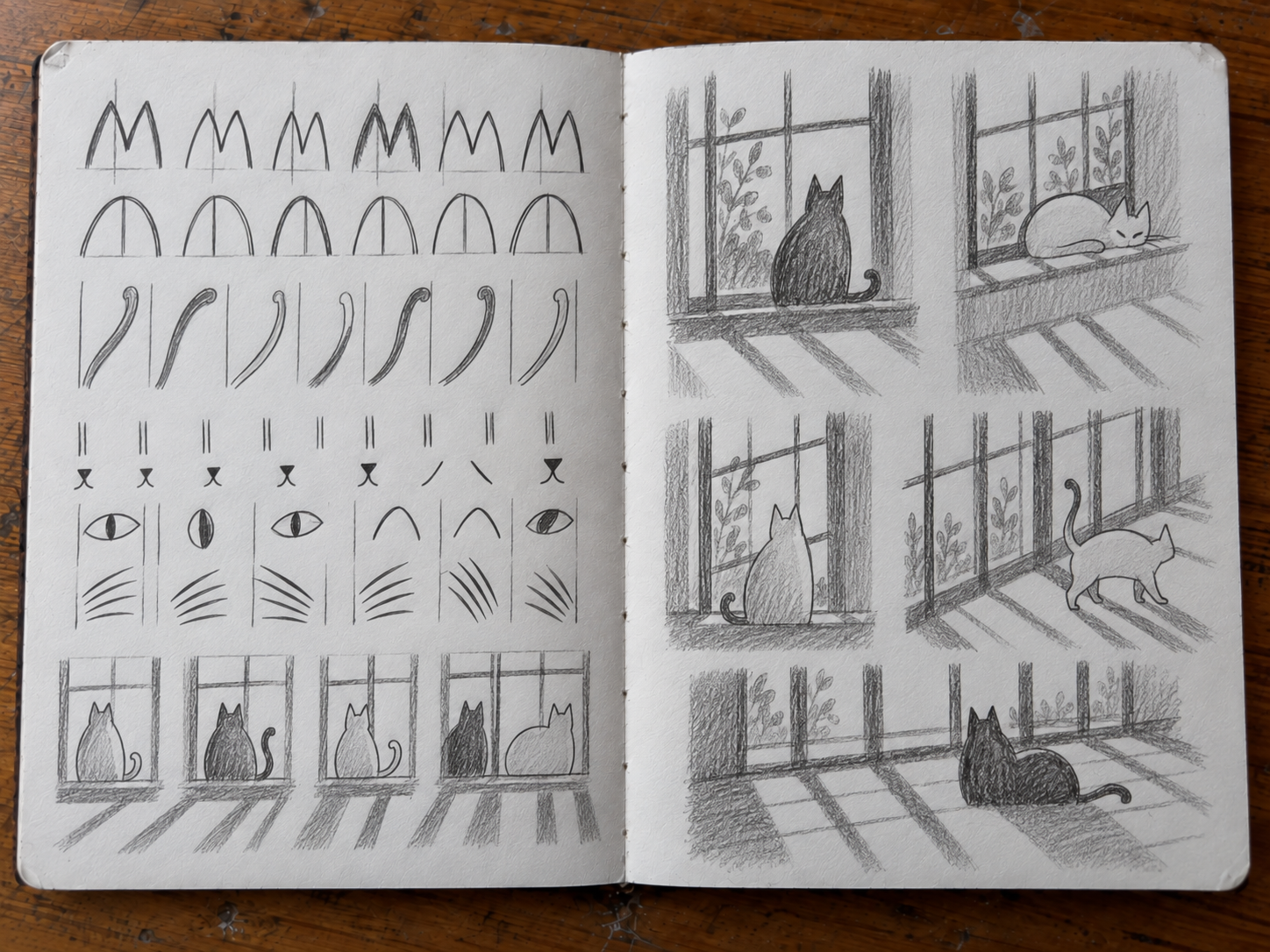
Visual material: Studio work, 2026.
02 /Look back
What changed?
Put your mark from Lesson 1 beside the family of marks you have now.
From 01
Earlier mark
Now
Developed mark family
Look across both
- What has begun to develop in your visual language?
- What stayed connected to the original meaning?
- What changed when place entered the work?
- Which decision feels most intentional now?
Circle or annotate one decision you want to carry forward.
Look together
Share the two stages of your work with another student.
- Notice — What do you notice?
- Evidence — What in the work makes you say that?
- Question — What are you curious about?
- Possibility — What could the artist test next?
Feedback gives you possibilities. You decide what belongs in your work.
Test what comes next
Choose one possibility from the conversation. You can:
Make one quick response in your Visual Diary.
Then ask:
What changed because of the feedback?
Keep in your visual diary
- Earlier mark + developed mark family
- One annotated decision
- Peer critique notes
- One small test
- One sentence about what you will carry forward
Next, marks and materials carry meaning through relationships, culture and continuity.
By the end of this lesson
- A developed family of marks connected to place
- Structural Lens notes on two visual decisions, using art terminology
- One decision annotated to carry forward
- One possibility tested after feedback
References
Source note
This Studio Guide was developed for Learning by Design using VCE Art Creative Practice curriculum guidance, museum material on Joan Miró and original Studio material. Linked Studio Building Blocks and Creative Thinking Toolkit pages carry their own source notes and references.
Curriculum + reading
Victorian Curriculum and Assessment Authority. (2022). VCE Art Creative Practice study design 2023–2027. VCAA Art Creative Practice ↗
Greenwood, D. (2023). Art creative practice: VCE units 1–4. Cambridge University Press & Assessment.
Victorian Curriculum and Assessment Authority. (n.d.). VCE Art Creative Practice: Teaching and learning. VCAA Teaching and Learning ↗
Artists + artworks
Miró, J. (1923–1924). The Hunter (Catalan Landscape) [Oil on canvas]. The Museum of Modern Art, New York. MoMA artwork source ↗
Klee, P. (1914). Hammamet with Its Mosque [Watercolour and graphite on paper mounted on cardboard]. The Metropolitan Museum of Art, New York. The Met artwork record ↗ Wikimedia Commons / Public domain image ↗
Studio material
PLACE ENTERING A DEVELOPING VISUAL LANGUAGE. Visual material: Studio work, 2026.