Studio Guide / Lesson 9 · Compare + interpret
Look together + build a comparison
Learning outcomeLook closely at two artworks, add context and build a comparison from evidence.
What students need to know
Key learning points
- Looking side by side reveals similarities and differences in visual language.
- Context helps explain how similar forms can carry different meanings.
- Comparison can connect place, materials and ideas across artist practices.
- A strong comparison explains why a difference matters using evidence.
Key terms
- side by side
- context
- comparison
- evidence
01 /Look together
Two works, side by side
Look at both before you go back to what you know about them.
- What appears similar?
- What appears different?
- Where do you notice simplified forms, repeated marks or signs?
- What evidence can you point to in each artwork?
Stay with what you can observe at this stage.
Keep in your visual diaryFirst side-by-side observations
02 /Add context
What changes when you know
where the marks come from?
Miró
- Place
- Montroig
- Catalan context
- Forms transformed into visual language
Clarke
- Family
- Country
- Community
- Cultural continuity
- Cultural authority
- Does something that looks similar necessarily carry the same meaning?
- What becomes different when you understand the context around each work?
Keep in your visual diaryContext comparison
03 /Build a comparison
A thinking structure
Both
helps identify a meaningful connection.
Both artists use simplified forms.
However
helps identify where the works differ.
However, the forms operate within different systems of meaning.
Because
explains why that difference matters, using evidence and context.
Because each artist works from a different relationship to place, culture and knowledge.
Use this structure to shape the comparison, then write it in your own words, using evidence you can point to in both artworks.
Keep in your visual diaryOne developed comparison
Compare the practices too
Look beyond what the artworks show. Consider how each artist’s practice is shaped by:
- How does each artist’s context shape the way the artwork was made?
- How does each artist’s practice affect what the artwork communicates?
- What becomes clearer when you compare the practices as well as the artworks?
Support the comparison with specific evidence.
Critique + feedback
Read your comparison to one other student. They are listening for whether the comparison holds together, not whether they agree with it.
- Which connection is clear?
- Which difference is doing the most work?
- Where does the evidence need to be more specific?
Change one part of your comparison after listening. Note what you changed and why.
Keep in your visual diaryOne change made after feedback
04 /Change the comparison
You have seen how one comparison can be built. Now change one of the artists. Bring forward one artwork from Week 4.
Choose a pair
Choose one Week 4 artwork and pair it with either Miró or Clarke. Then choose one thing worth comparing:
- What connects the practices?
- Where do they differ?
- Why does that difference matter?
- What artwork evidence supports your interpretation?
- What source supports the contextual information you are using?
Keep in your visual diarySecond comparison + source
By the end of this lesson
- First side-by-side observations
- A context comparison
- One developed comparison
- One change made after feedback
- A second comparison supported by a source
References
Curriculum + reading
Greenwood, D. (2023). Art creative practice: VCE units 1–4. Cambridge University Press & Assessment.
Artists + artworks
Maree Clarke. Walert – gurn barerarerungar: Tipperary, Ireland Dunstable, Britain Yorta Yorta Trawlwoolway Boonwurrung, Mutti Mutti, Wamba Wamba, 2020–21. NGV ↗
megan evans. Bleeding Chandelier, 2016. megan evans / project ↗
Joan Miró. The Hunter (Catalan Landscape), Montroig, July 1923–winter 1924. MoMA ↗
Peter Waples-Crowe. Colonised 3, 2017. Exhibition catalogue ↗
Museum + gallery sources
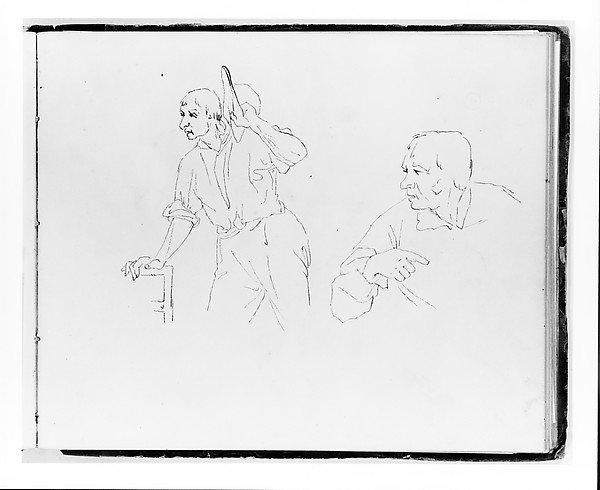
Edmonds, F. W. (n.d.). Two studies of a man (from sketchbook). Accession 1987.196.3o recto. The Metropolitan Museum of Art, New York. Public domain. The Metropolitan Museum of Art ↗