09 / The Studio · Material
MARK MAKING
Hatching · Crosshatching · Stippling
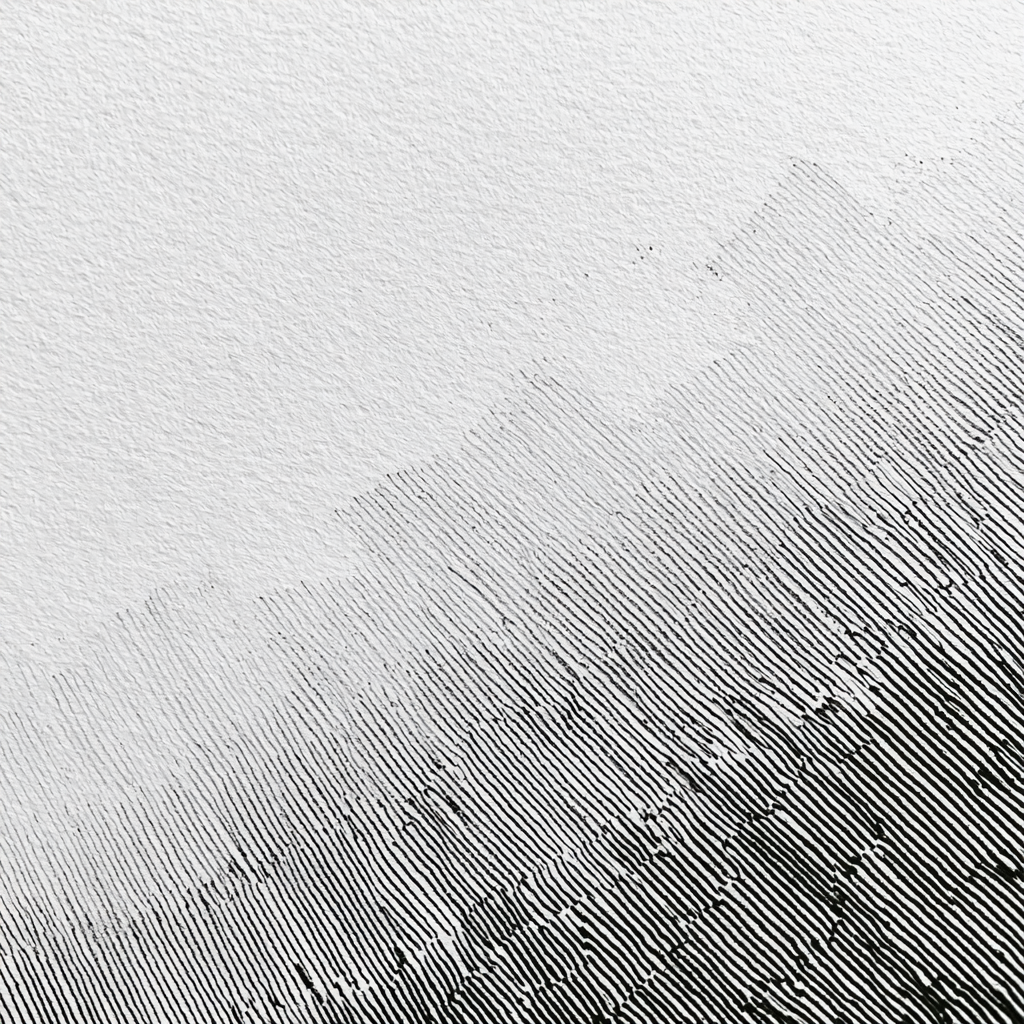
A single mark can be light, dark, soft, sharp, regular or uneven. Repeat it, move it closer to another mark, change its direction or layer it, and something begins to happen.
Marks can build value, describe a surface and help a flat shape begin to feel three dimensional.
TODAY’S FOCUS
Repeat, gather and change marks to build value, surface and form.
Look
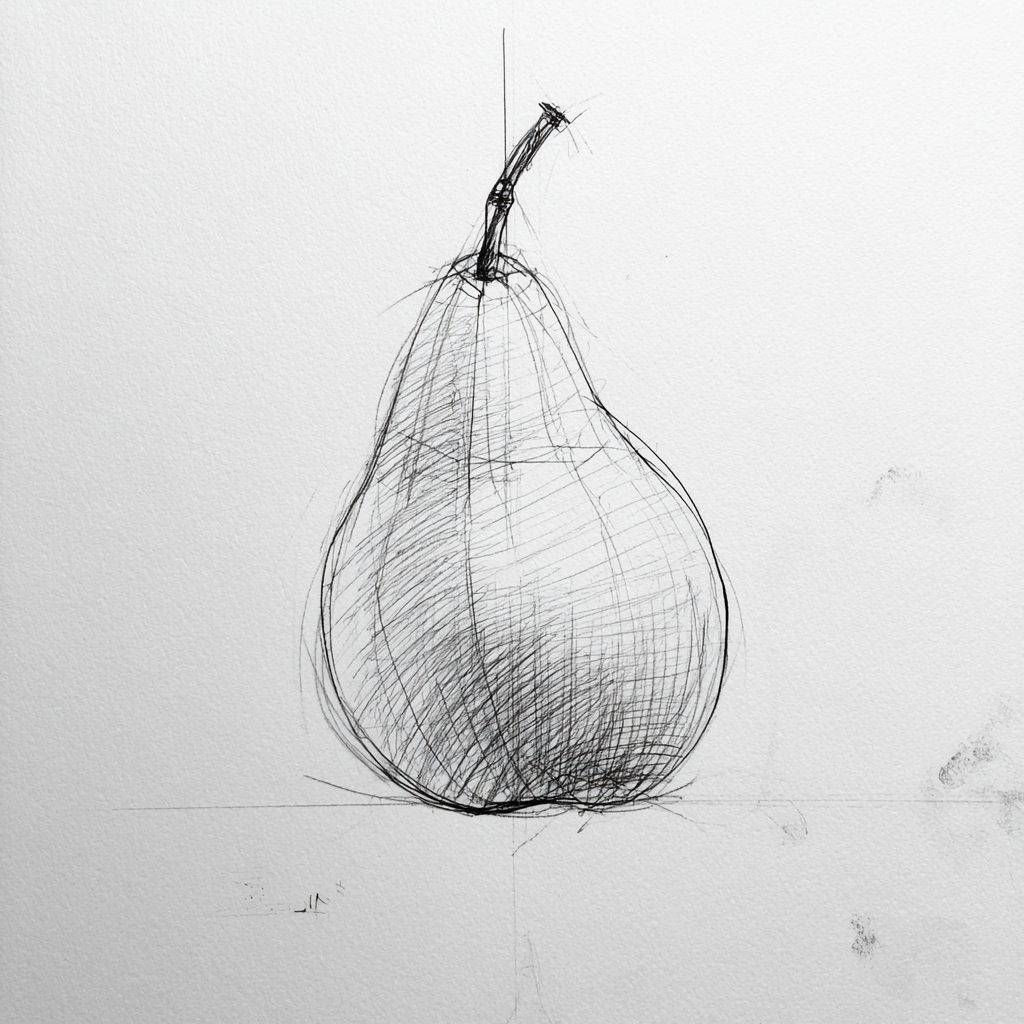
Visual material: Studio work, 2026.
TRY IT / DOODLING
Let your hand keep moving
Doodling can begin before you know what you want to make.
Start with one mark. Repeat it. Stretch it. Turn it. Join it to another. Let it change.
Notice what your hand keeps returning to.
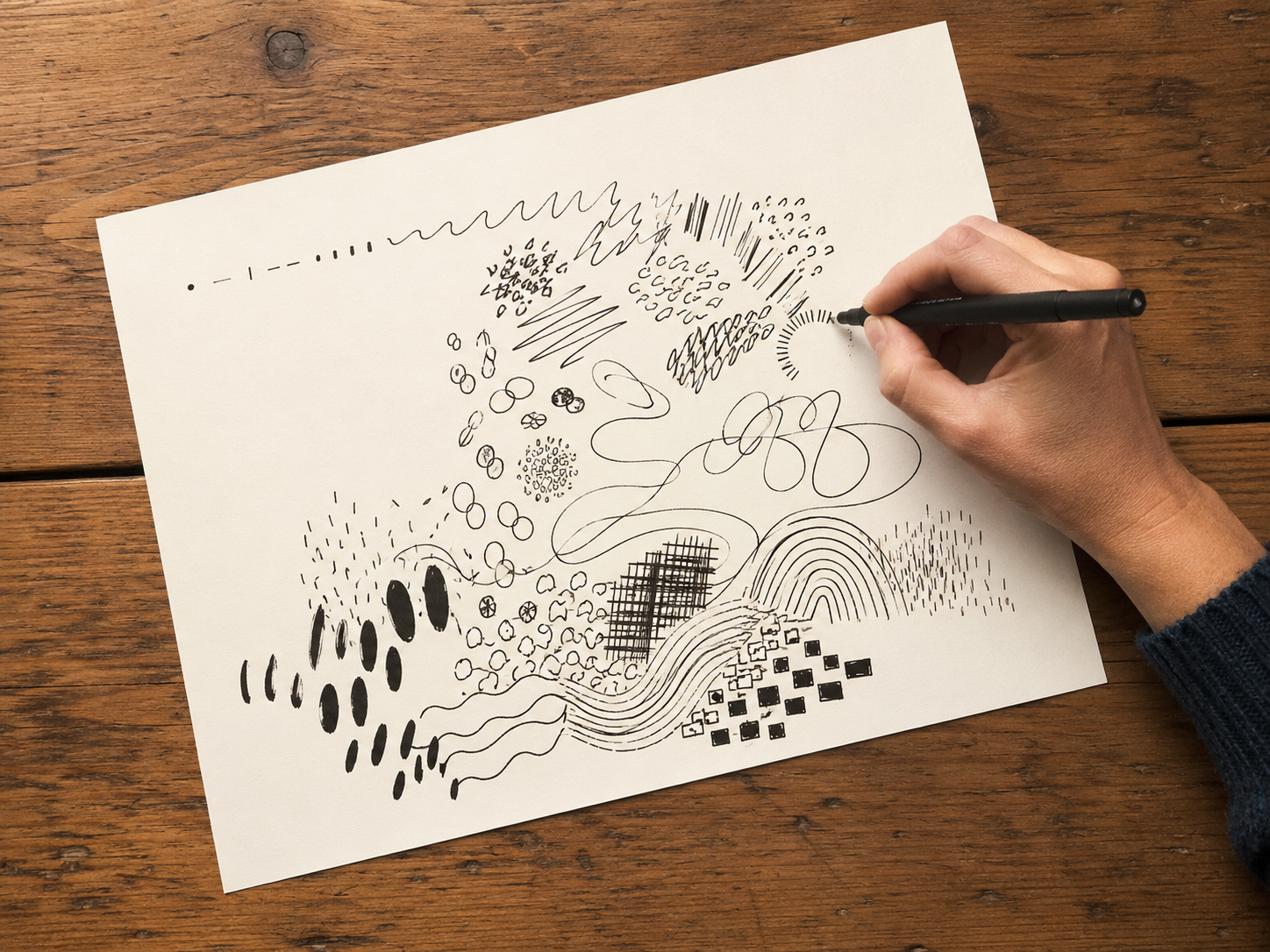
01 / FOLLOW A MARK
Start anywhere on the page. Let one mark lead to the next.
Keep moving for a while before deciding what the drawing is becoming.
02 / REPEAT SOMETHING
Choose one mark. Repeat it. Change its scale, spacing, direction and pressure.
Watch what happens when the same mark behaves differently.
03 / NOTICE WHAT RETURNS
Look across the page. Which marks, movements or rhythms keep appearing?
Circle one or two that you want to try again.
LOOK + NOTICE
PATTERNS ARE ALREADY AROUND YOU
Look closely at something nearby. You might notice a rhythm in tiles, fabric, leaves, handwriting, pavement, shadows, fences, hair or packaging.
Choose one. Draw what you notice. Then let the pattern change as you continue.
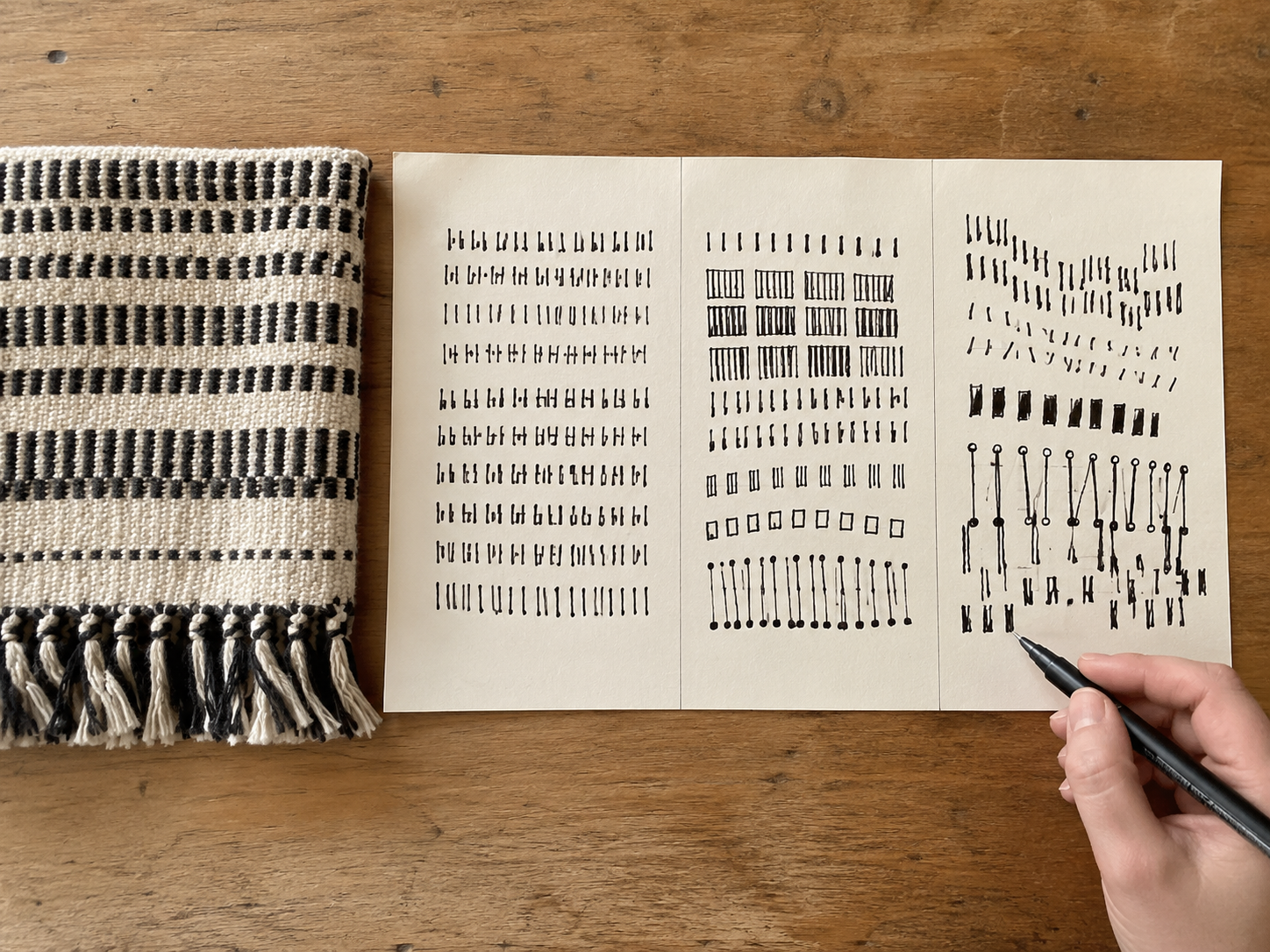
WHAT FEELS LIKE YOURS?
Look back across what you made. Which marks do you want to keep?
Try them again on another part of the page. Change them. Combine them. See whether a small vocabulary begins to appear.
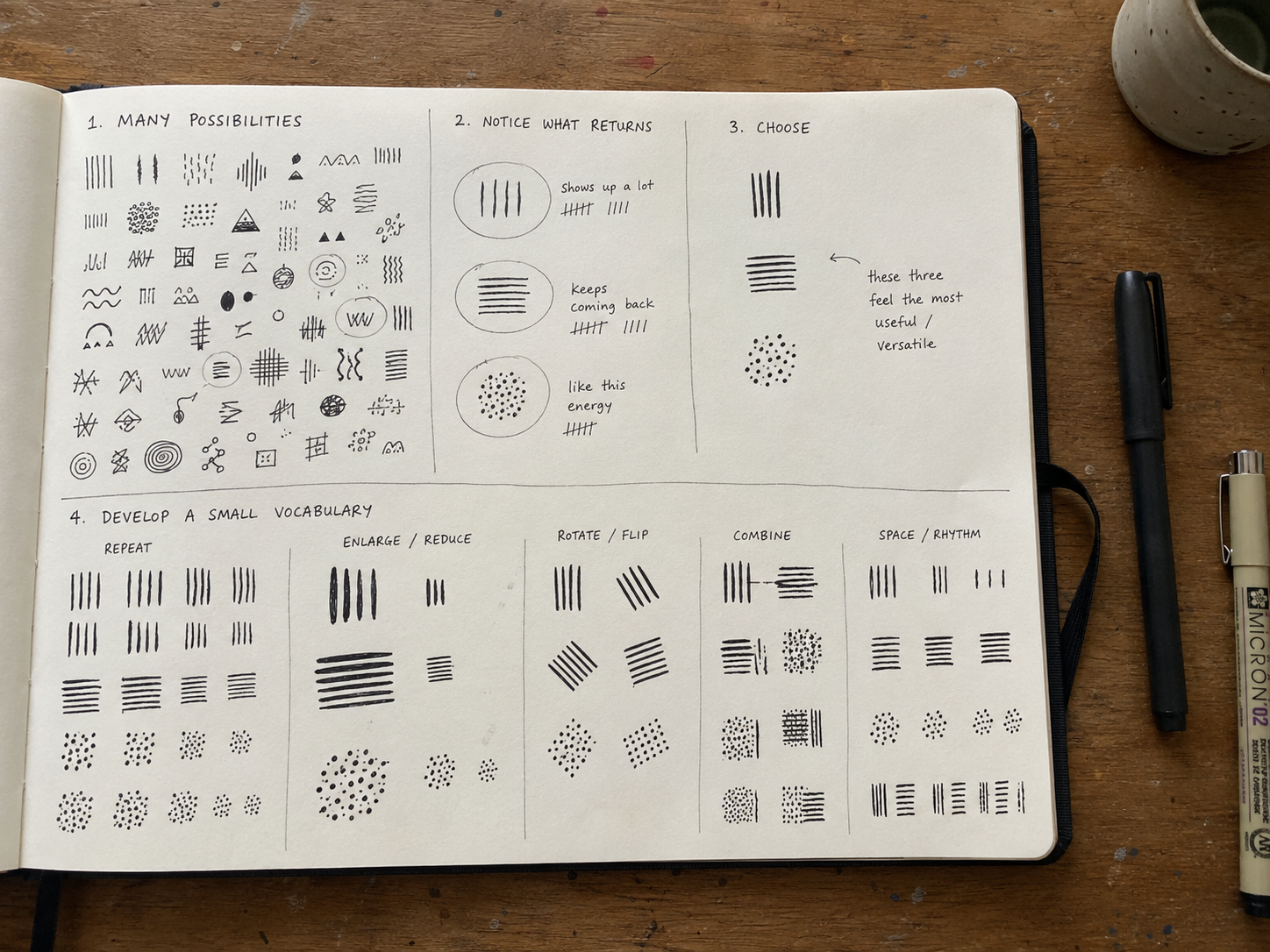
Try
ONE MARK, MANY POSSIBILITIES
THREE WAYS OF MAKING VALUE Studio diagram.
SEE WHAT YOUR MARKS CAN DO
Take a pencil or fine black pen and make three small areas in your visual diary.
Try:
- hatch
- crosshatch
- stipple
Begin with plenty of space between the marks. Slowly bring them closer together.
WHAT CHANGED?
OPEN TO DENSE Studio diagram.
Materials
- Drawing paper or visual diary
- Graphite pencil
- Black fineliner or drawing pen
- Eraser
- A simple object or small still life
Material encounter
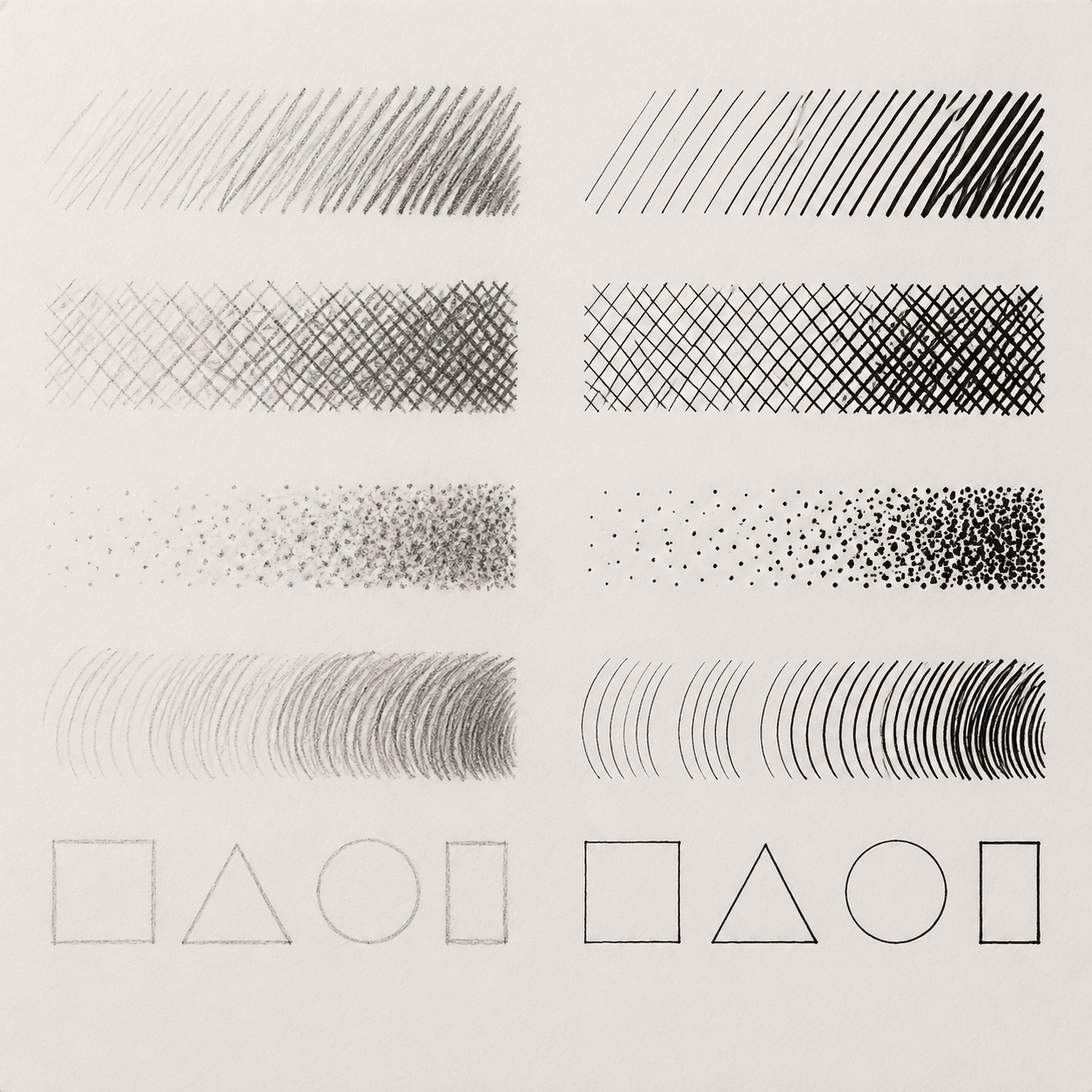
SAME ACTION, DIFFERENT MATERIAL
Make the same group of repeated marks twice.
Try it first with graphite.
Try it again with a black fineliner or drawing pen.
Keep the action as similar as you can.
WHAT CHANGED WHEN THE MATERIAL CHANGED?
Students might notice differences in:
- softness
- edge
- pressure
- darkness
- texture
- control
Understand
DENSITY CHANGES VALUE
Plenty of paper still showing between the marks.
As marks become closer, denser or more layered, we begin to read the area as darker.
The material has not changed. What changed was how the marks gathered and how much paper remained visible.
Understand
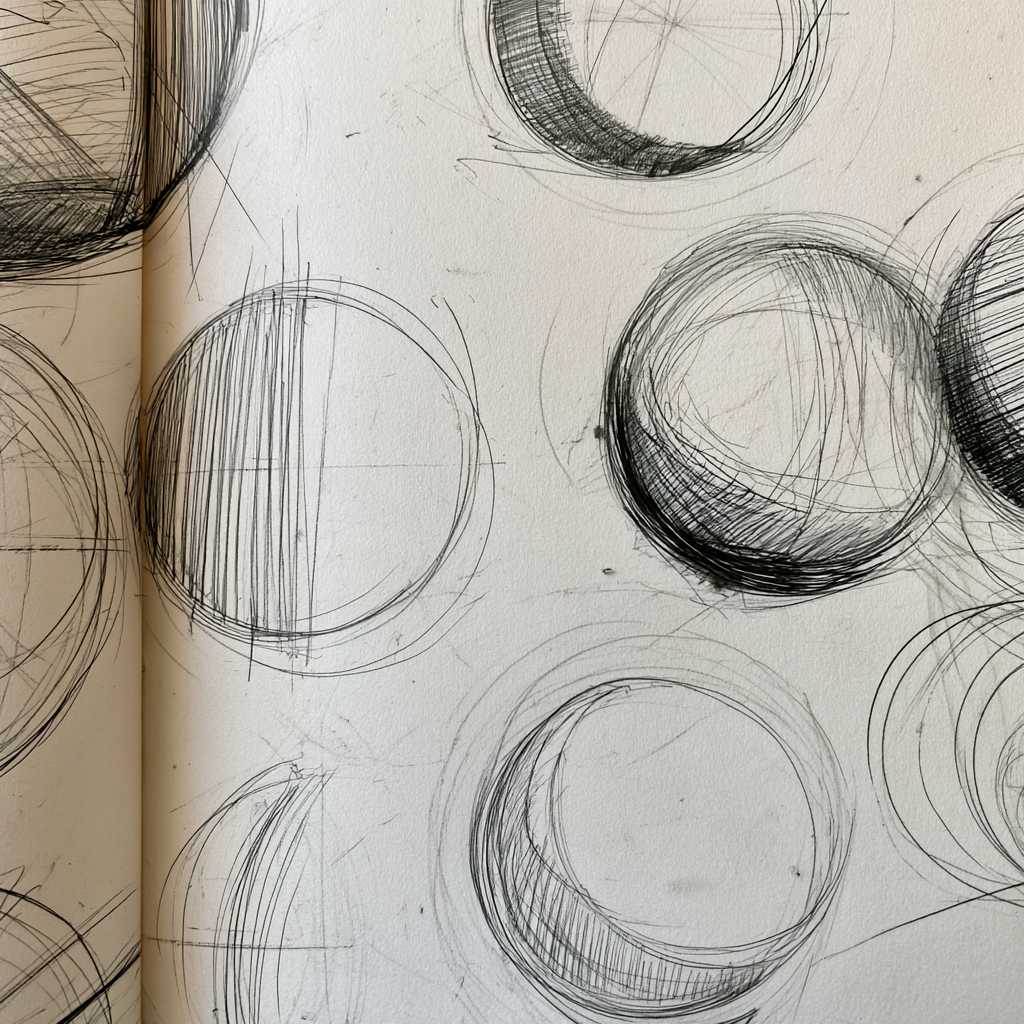
LET THE MARKS TURN WITH THE SURFACE
Marks can describe more than light and dark. On a rounded object, marks can begin to turn with the surface. As the surface changes direction, the marks can change with it.
Straight marks across a flat circle.
Curved marks following a form as it turns.
DIRECTION + FORM Studio diagram.
Visual material: Studio work, 2026.
Look again
REMBRANDT VAN RIJN
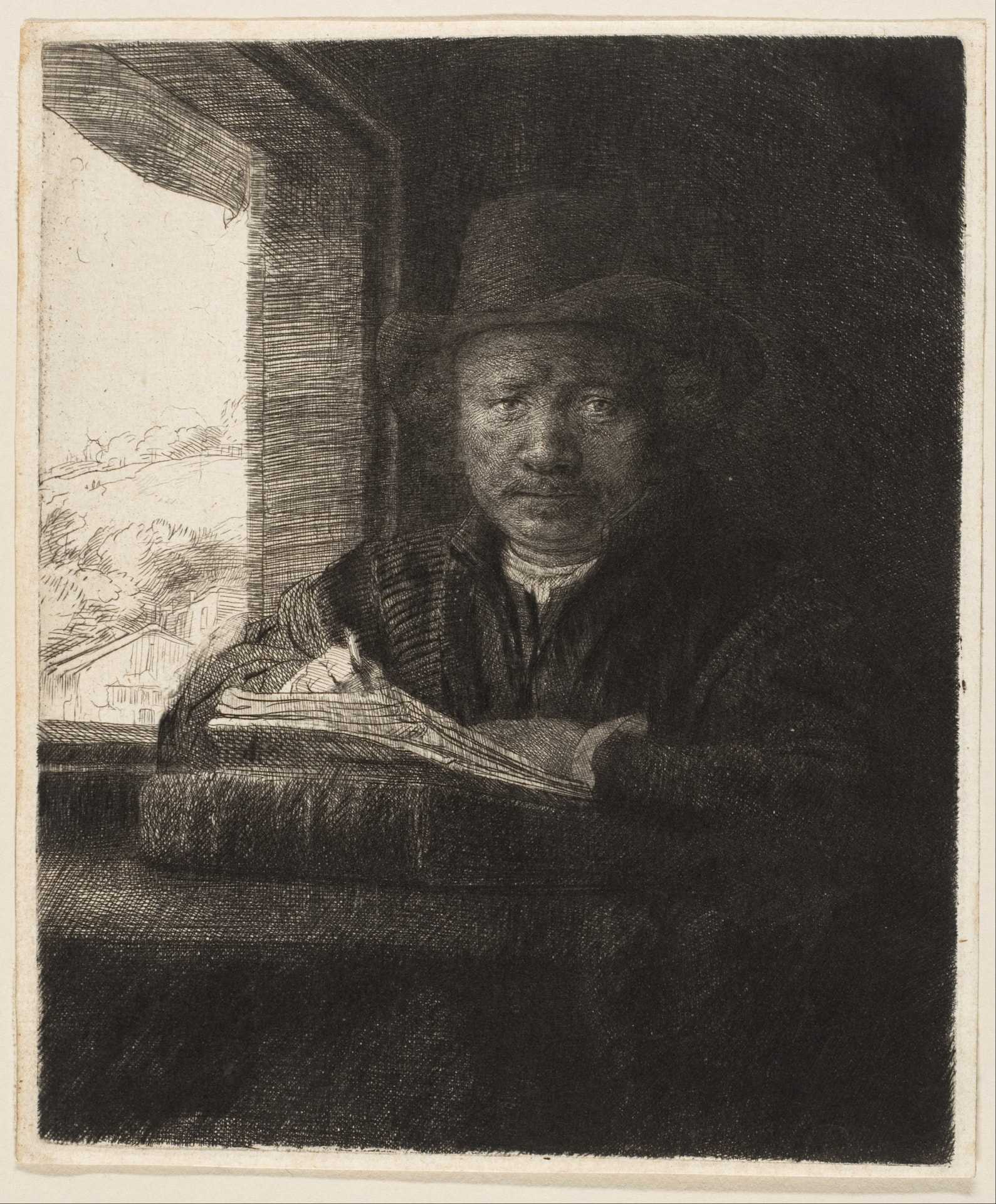
DENSITY, VALUE, SHADOW
Begin with the face. Follow some of the lines into the darker areas around it. Notice where the marks remain separate and where they begin to gather.
At what point do you begin to see shadow rather than individual lines?
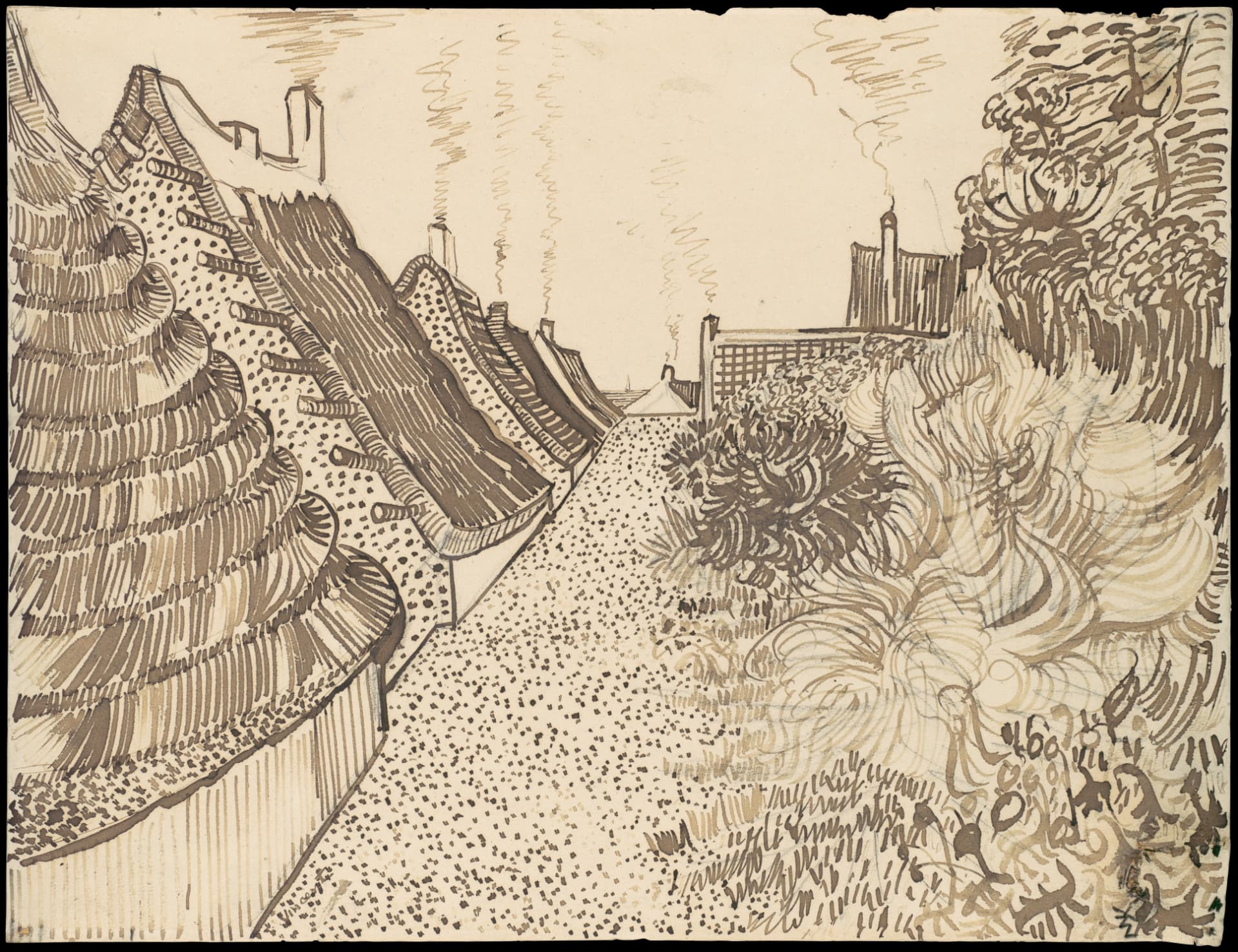
VINCENT VAN GOGH
DIRECTION, SURFACE, ENERGY
Let your eye move across the street, buildings and sky. Notice how often the marks change. Where do marks become shorter, longer, closer, looser or change direction?
What begins to happen to the surface when the marks change?
Make
CHOOSE SOMETHING TO LOOK AT
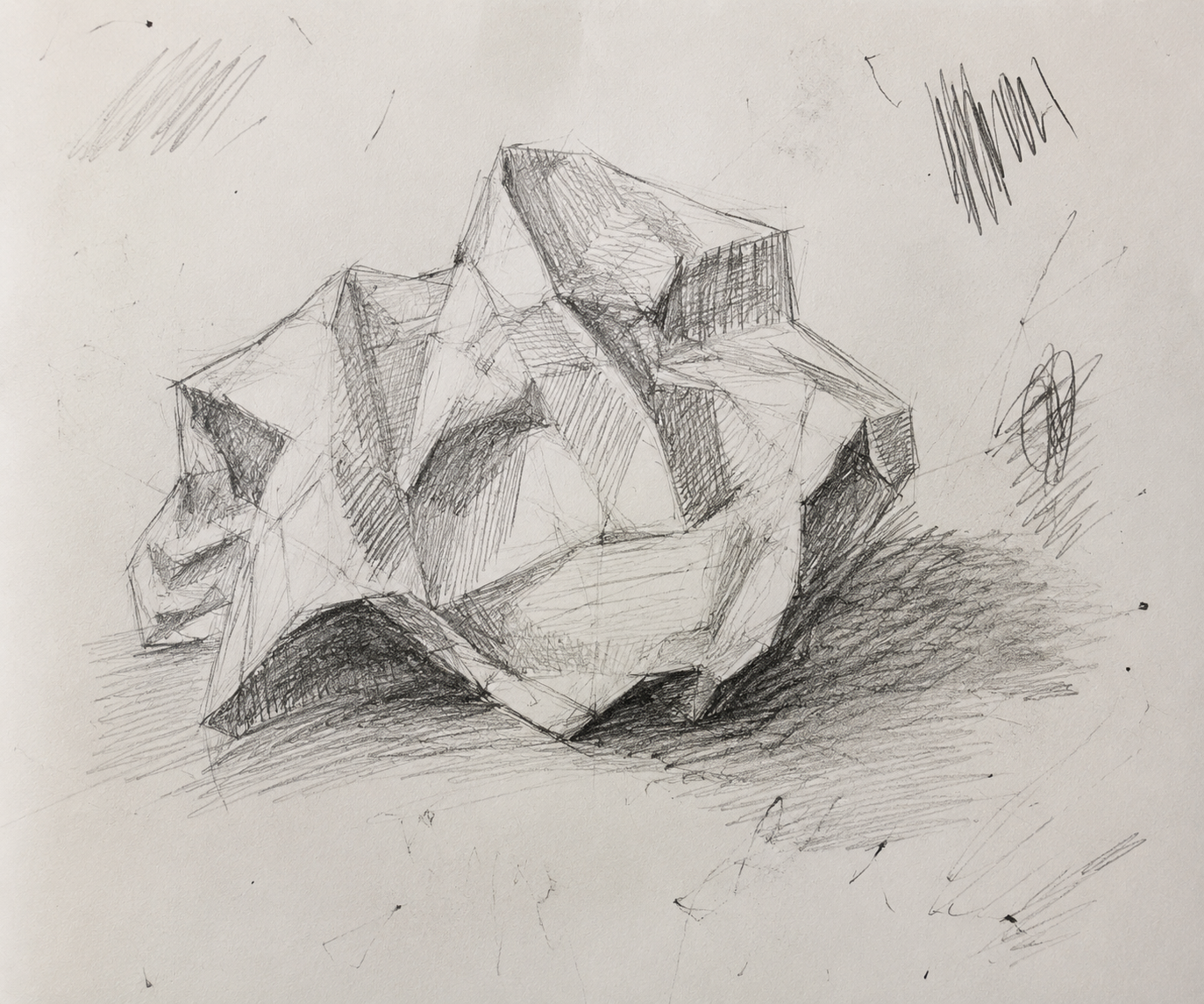
Visual material: Studio work, 2026.
Find a simple object with a clear form — a cup, pear, shell, shoe, piece of fruit or crumpled piece of paper. Place it somewhere with light coming mainly from one direction.
Spend a little time looking before drawing. Begin lightly, finding the overall shape and proportion.
Then notice:
- Where is it light?
- Where is it somewhere in between?
- Where is it dark?
Choose one kind of repeated mark to begin describing those changes.
Pencil, fineliner or another material that allows repeated marks will work.
BUILD SLOWLY
Begin with the lighter areas, letting some of the paper remain visible. As you move toward darker areas, the marks can become closer, denser or more layered.
Moving around the drawing rather than finishing one small area lets the values develop together. Look back at the whole object as you work.
Pause + look
Put your drawing down and move back a little.
Where is the darkest area?
Where is the lightest?
Do your marks change as the surface turns?
Is there somewhere the marks could become quieter?
Return to the drawing and try one small change.
Marks can suggest surface too
The same marks that build value can begin to suggest texture. Short broken marks might feel rough. Long repeated lines might suggest fibres or grain. Dense dots create a different surface again.
Look at the object in front of you.
What kind of mark seems to belong to its surface?
Marks can build tone
Bring marks closer together and an area begins to look darker. Spread them apart and more of the paper shows through.
TRY IT
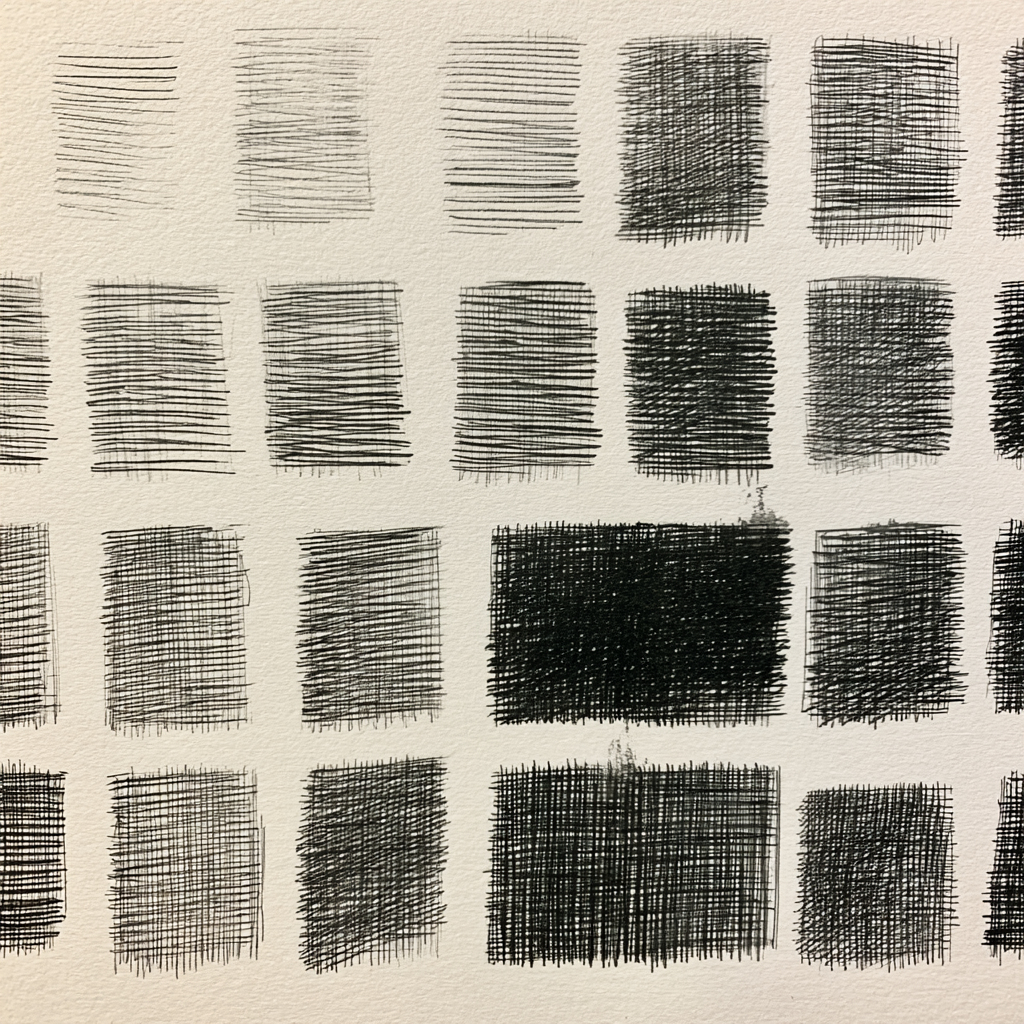
Make the same kind of mark three ways: sparse, then closer, then dense.
WHAT HAPPENS TO THE VALUE?
Original studio image / to add · 03
Marks build tone
Three handmade samples of the same mark — widely spaced, closer together, then dense — so light, middle and dark emerge from the density alone. Black pen, graphite or charcoal on paper.
WATCH
In your practice
Repeated marks can shape tone, texture, form and visual language. Notice how changing the direction, density or character of a mark changes the way the subject is experienced.
Test how different materials and drawing techniques change the marks you can make. Keep the trials that show what changed and what you may want to develop further.
Marks can distinguish surfaces, suggest materials and direct attention. Changes in line, density and texture can become part of the visual language of a communication.
Document
KEEP THE TESTS
Keep the small hatching, crosshatching and stippling experiments beside your observational drawing. They show how you arrived at the marks you chose.
If you find a mark or combination that interests you, try it again on another surface or object later.
Creative thinking
Where do individual marks begin to become value or surface?
What changed when you changed density, direction or material?
Keep one mark test beside your drawing that shows a choice you made.
Tools to help you notice, describe, question, develop and document your work.
Curriculum + reading
Bowden, M., & Tooke, A. (2022). Art making and exhibiting: VCE units 1–4. Cambridge University Press & Assessment.
Greenwood, D. (2023). Art creative practice: VCE units 1–4. Cambridge University Press & Assessment.
Guthrie, K. (2017). Nelson visual communication design: VCE units 1–4 (4th ed.). Cengage Learning Australia.
Lemon, K. (2014). Fearless drawing: 22 illustrated adventures for overcoming artistic adversity. North Light Books.
Victorian Curriculum and Assessment Authority. (2022). VCE Art Creative Practice study design 2023–2027. vcaa.vic.edu.au ↗
Victorian Curriculum and Assessment Authority. (2022). VCE Art Making and Exhibiting study design 2023–2027. vcaa.vic.edu.au ↗
Victorian Curriculum and Assessment Authority. (2023). VCE Visual Communication Design study design 2024–2028. vcaa.vic.edu.au ↗
Artists + artworks
Rembrandt van Rijn. (1648). Self-portrait etching at a window [Etching, drypoint and burin]. The Metropolitan Museum of Art, New York, NY, United States. The Sylmaris Collection, Gift of George Coe Graves, 1920 (20.46.12). Public domain. metmuseum.org ↗
Van Gogh, V. (1888). Street in Saintes-Maries-de-la-Mer [Reed pen, quill and brown ink over graphite on wove paper]. The Metropolitan Museum of Art, New York, NY, United States. Bequest of Abby Aldrich Rockefeller, 1948 (48.190.1). Public domain. metmuseum.org ↗
Studio material
OBSERVATIONAL PEAR STUDY.
Three Ways of Making Value.
Open to Dense.
Hatching Test.
Same Action, Different Material.
Direction + Form.
SPHERE STUDIES.
OBSERVATIONAL STUDY IN PROGRESS.
Mark Tests.
Visual material: Studio work, 2026.