Studio Guide / Lesson 6 · Belonging + continuity
Cultural authority + developing relationships
Learning outcomeConsider cultural authority when interpreting artist practice, then develop relationships within your own visual language.
What students need to know
Key learning points
- Cultural authority affects who can hold, share and interpret particular cultural knowledge.
- Artist voice and authoritative sources help us distinguish observation from contextual knowledge.
- Artists can work through relationships between people, place, material, memory and culture.
- Visual relationships can be developed through spacing, repetition, touching, separation and interruption.
- Ideas encountered in another artist’s practice can inform your thinking without copying their cultural forms or symbols.
Key terms
- cultural authority
- relationships
- source
- evidence
01 /Cultural authority
Who holds the knowledge?
Return to Maree Clarke’s work and the sources from Lesson 5. Some materials, practices, stories and forms of knowledge sit within particular cultural relationships and responsibilities. Cultural authority asks us to consider who holds that knowledge, who has shared it, and what we have a basis for interpreting.
- What can you understand from looking closely at the artwork?
- What has Clarke herself shared about her practice?
- What additional context comes from the NGV?
- Which parts of your interpretation depend on knowledge held by the artist or community?
Stay with what the artist, community or authoritative source has shared publicly.
Bring this into your own practice
Notice how relationships between making, memory, place and cultural knowledge matter within Clarke’s practice. Carry that way of thinking into your own work through material that belongs to your own experience, relationships, places and observations.
Clarke’s cultural imagery, symbols and practices stay with her and her communities. The connection you take is in the thinking: how meaning can be carried through relationships.
Keep in your visual diaryCultural authority note
Keep track
- Observation
- What can you point to directly in the artwork?
- Source
- What has Clarke, the NGV or another authoritative source told you?
- Interpretation
- What can you now reasonably say about the work?
Core sources
The NGV artwork record and the NGV Ancestral Memories material from Lesson 5 remain the core sources for this encounter.
02 /Develop relationships
Return to your own marks.
Bring forward the marks you developed in Lesson 5. Look at the relationships already beginning to form between them, then test what happens when those relationships change.
Move 1 / Repeat + connect
Continue changing:
Move 2 / What sits around the mark?
Think about what gives the mark its meaning within your own experience. It might connect to a relationship, place, memory or event. Let one of those connections enter the page through drawing, small words, lines, placement, repetition or another visual decision that makes sense within your work.
Keep the tests together so you can see how the relationships develop.
Keep in your visual diaryDeveloped mark relationships
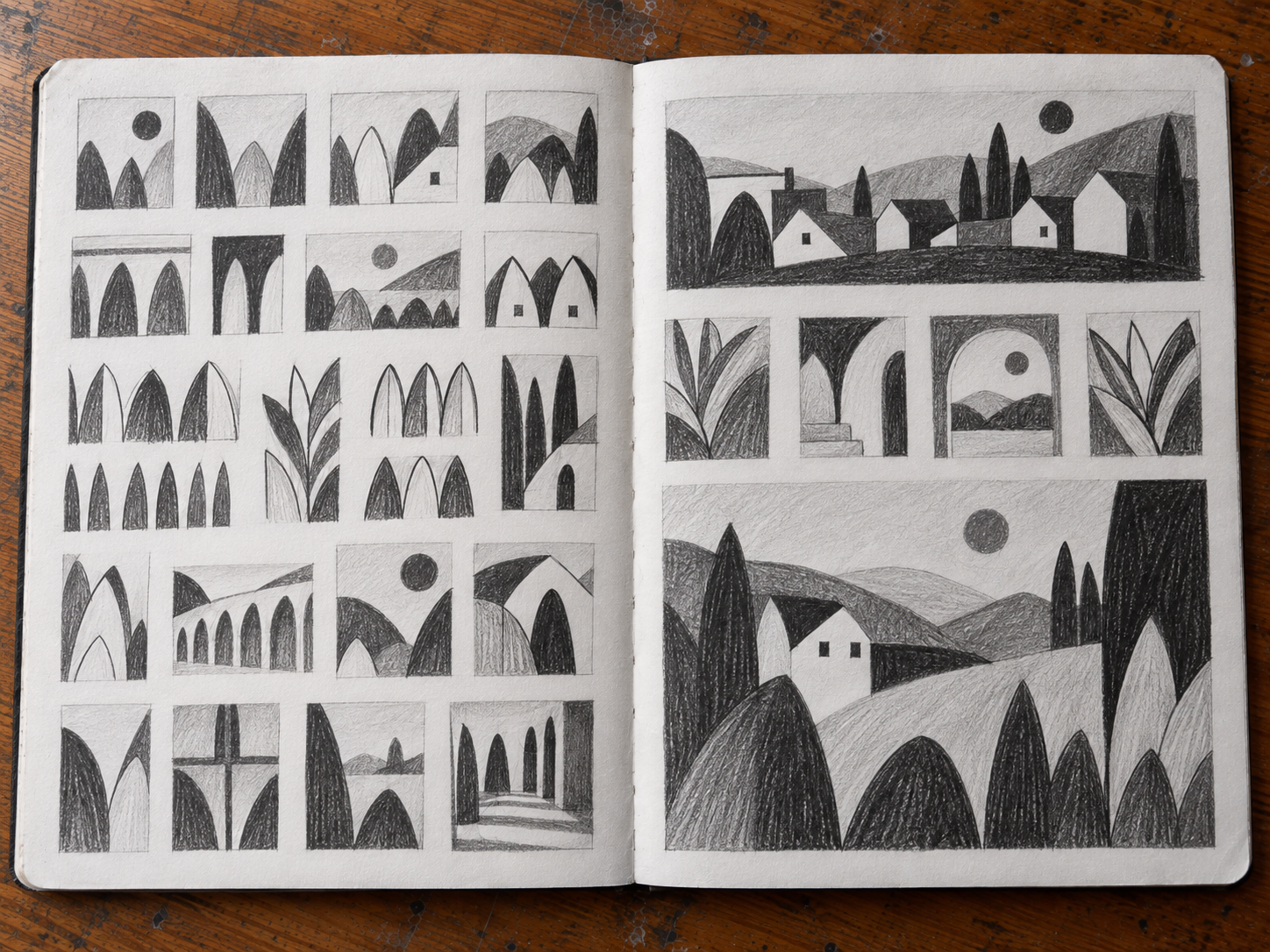
Visual material: Studio work, 2026.
03 /Look back
What changed?
Earlier
Mark
Now
Developed relationships
Put an earlier version of your mark beside what you have now.
- What changed when you considered the relationships behind the mark?
- What changed through repetition, spacing or connection?
- Which relationship now feels important to the work?
- What will you carry forward?
Keep both stages in your Visual Diary so the development remains visible.
Keep in your visual diaryBefore + after, one decision to carry forward
Next, how an artist’s position in history shapes the meaning of their work.
By the end of this lesson
- A cultural authority note for your own practice
- Developed mark relationships
- A before + after reflection, with one decision to carry forward
References
Source note
This Studio Guide was developed for Learning by Design using VCE Art Creative Practice curriculum guidance, authorised National Gallery of Victoria material on Maree Clarke, First Nations cultural protocols and original Studio material. Linked Studio Building Blocks and Creative Thinking Toolkit pages carry their own source notes and references.
Curriculum + reading
Creative Australia. (n.d.). Protocols for using First Nations cultural and intellectual property in the arts. First Nations protocols ↗
Greenwood, D. (2023). Art creative practice: VCE units 1–4. Cambridge University Press & Assessment.
Victorian Curriculum and Assessment Authority. (n.d.). VCE Art Creative Practice: Teaching and learning. VCAA Teaching and Learning ↗
Victorian Curriculum and Assessment Authority. (2022). VCE Art Creative Practice study design 2023–2027. VCAA Art Creative Practice ↗
Artists + artworks
Clarke, M. (2020–2021). Walert – gurn barerarerungar: Tipperary, Ireland Dunstable, Britain Yorta Yorta Trawlwoolway Boonwurrung, Mutti Mutti, Wamba Wamba [Possum skin, earth pigments, synthetic polymer paint and sinew]. National Gallery of Victoria, Melbourne. NGV artwork source ↗
Museum + gallery sources
National Gallery of Victoria. (2021). Maree Clarke: Ancestral Memories: Exhibition introduction [Video]. NGV / Ancestral Memories ↗
Studio material
PLACE AND RELATIONSHIPS ENTERING A DEVELOPING VISUAL LANGUAGE. Visual material: Studio work, 2026.