05 / The Studio
PROPORTION + SCALE
Comparing the size of parts, objects and the space around them.
What is it?
Proportion and scale both compare size, but they compare different things.
Proportion compares the size of one part with another part or with the whole.
part ↔ part
part ↔ whole
Scale compares the size of something with another object, the space around it or the viewer.
object ↔ object
object ↔ space
object ↔ viewer
TODAY’S FOCUS
Compare relationships of size and notice what changes.
Look
COMPARE BEFORE YOU DRAW
How big is it compared with something else?
Before drawing a part, compare it with another part. Ask:
How wide is the object compared with its height?
Where is the halfway point?
How large is one part compared with another?
LOOK FOR RELATIONSHIPS BEFORE DRAWING DETAILS.
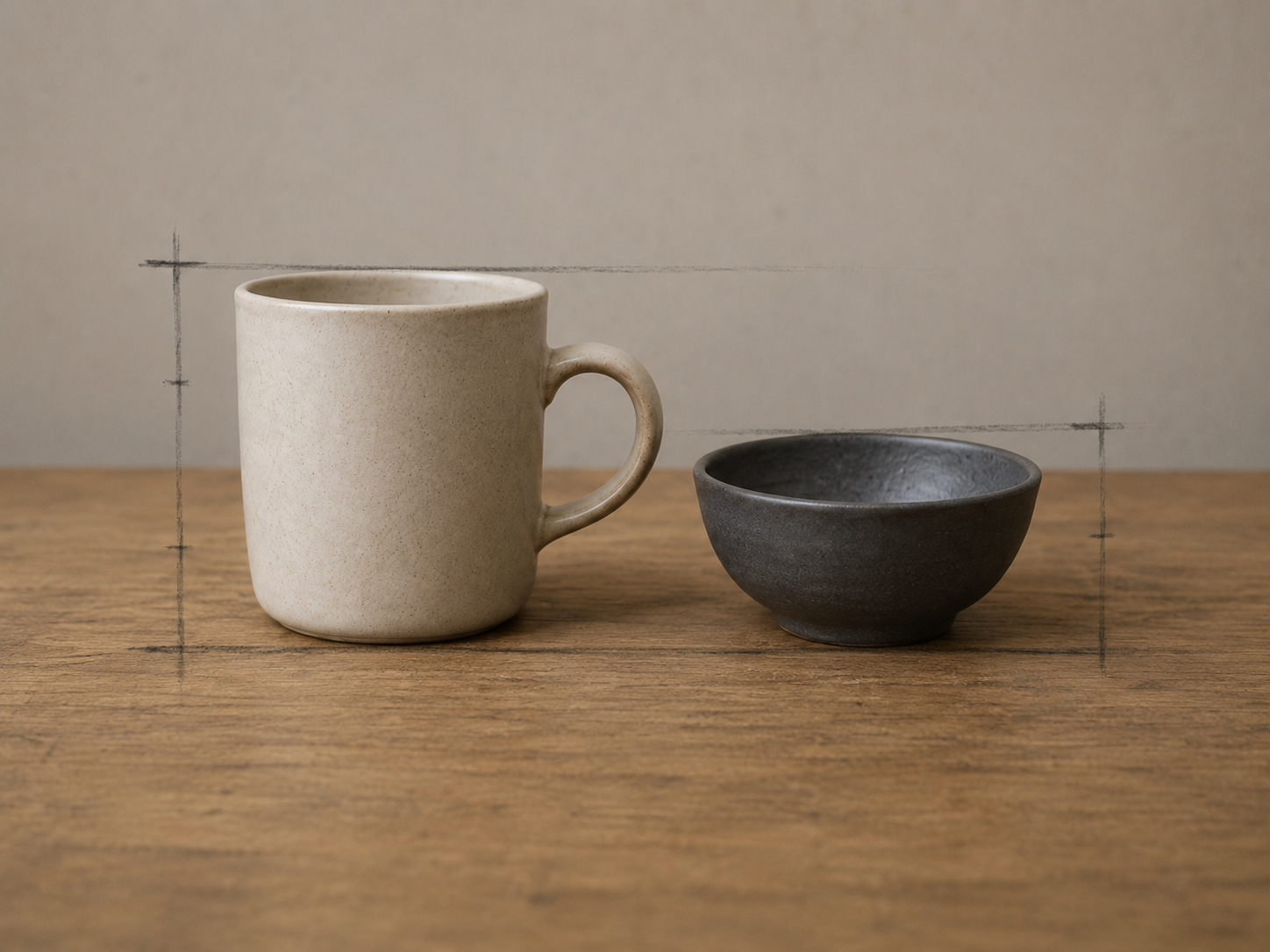
Studio exercise.
Try
MEASURE BY COMPARISON
STUDIO METHOD
Measure what you actually see.
Place a simple object in front of you.
Hold a pencil vertically at arm’s length and close one eye. Use your thumb to mark the height of the object on the pencil.
Compare that height with its width. Is it twice as high as it is wide? Almost equal? Somewhere between?
Make a quick drawing from that relationship.
Check it again.
CHECK
Compare the drawing with the object.
Which relationship is closest?
Where did you make something:
- too long
- too short
- too wide
- too narrow
Adjust it. Look again.
COMPARE → DRAW → CHECK → ADJUST
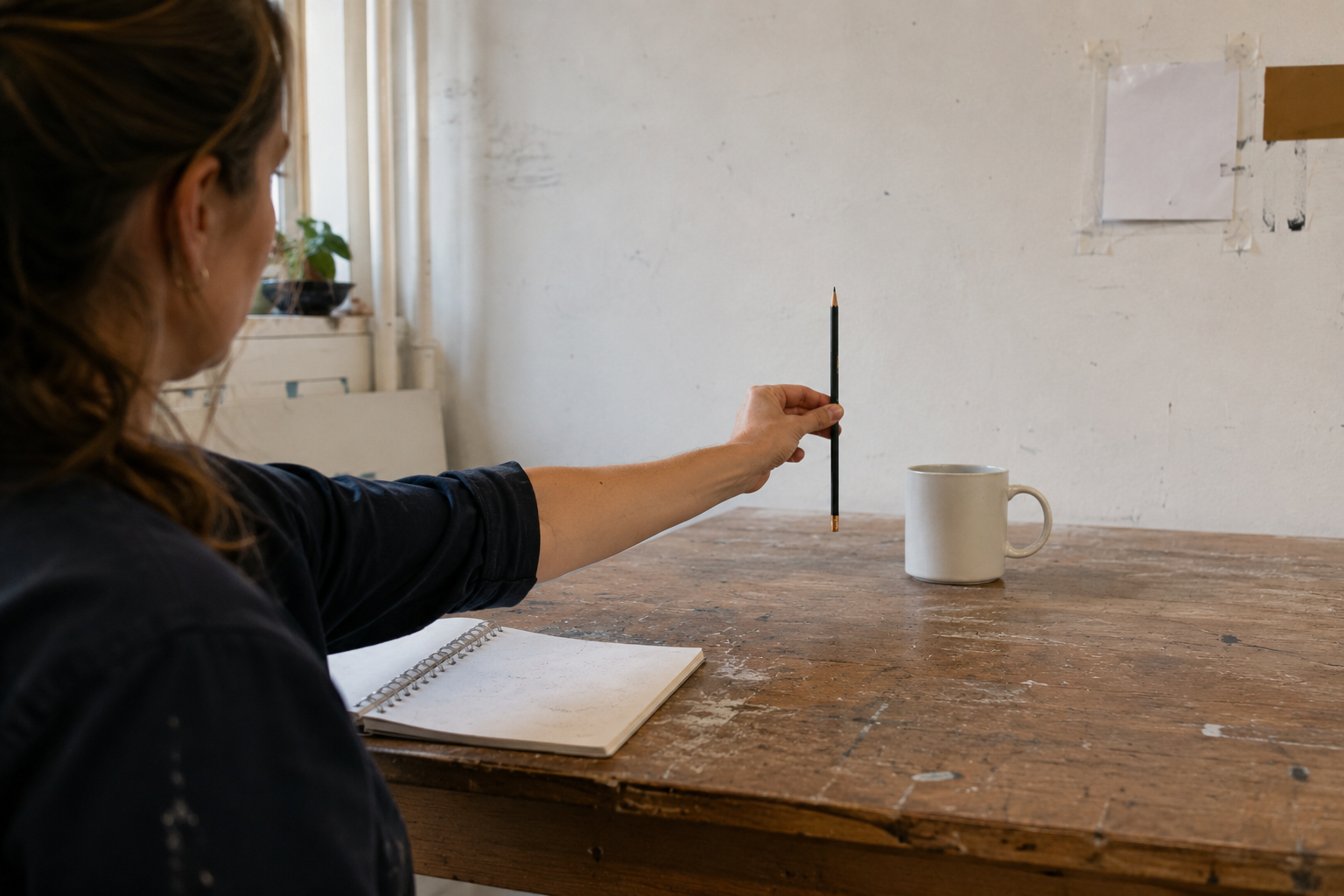
Studio demonstration.
WATCH
Materials
Material encounter
USE ONE PART TO CHECK ANOTHER
Choose one part of what you are looking at.
Use it as your measuring unit.
Compare another part with it.
HOW MANY TIMES DOES ONE FIT INTO THE OTHER?
Try the comparison again before you draw.
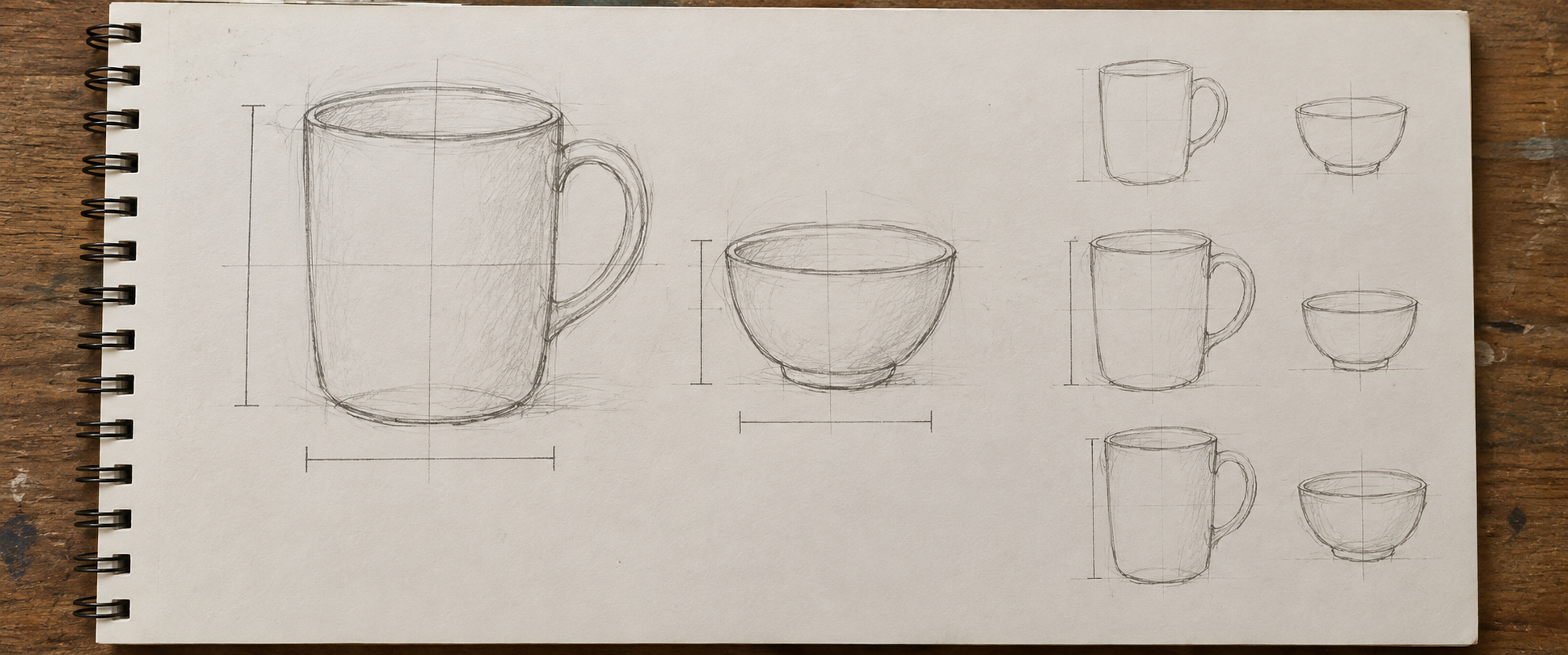
Studio exercise.
Understand
PROPORTION
Proportion is about relationships between parts.
Using a unit
A part of the subject can become a unit for comparing the whole. In figure drawing, the head is often used this way.
In figure drawing, an adult figure is often represented using a guide of approximately 7½–8 head lengths.
THE GUIDE IS ONLY A STARTING POINT. MEASURE THE PERSON IN FRONT OF YOU.
Using a unit. Studio diagram.
Studio diagram.
Make
OBSERVATIONAL PROPORTION
Draw through comparison.
Work from life. Use yourself in a mirror or another person in front of you.
Begin with the large relationships:
- overall height and width
- midpoint
- largest shapes
- size of one part compared with another
- placement of the figure on the page
Draw, compare and check as you work.
A finished anatomical drawing is not the aim. The focus is judging relationships of size.
- 01 / Look
Look at the whole figure.
- 02 / Compare
Compare height with width.
- 03 / Midpoint
Find the midpoint.
- 04 / Unit
Choose one part as a measuring unit.
- 05 / Measure
Compare another part with it.
- 06 / Draw
Draw the large shapes.
- 07 / Check
Check the drawing against the person.
- 08 / Adjust
Adjust what you notice.
COMPARE → DRAW → CHECK → ADJUST
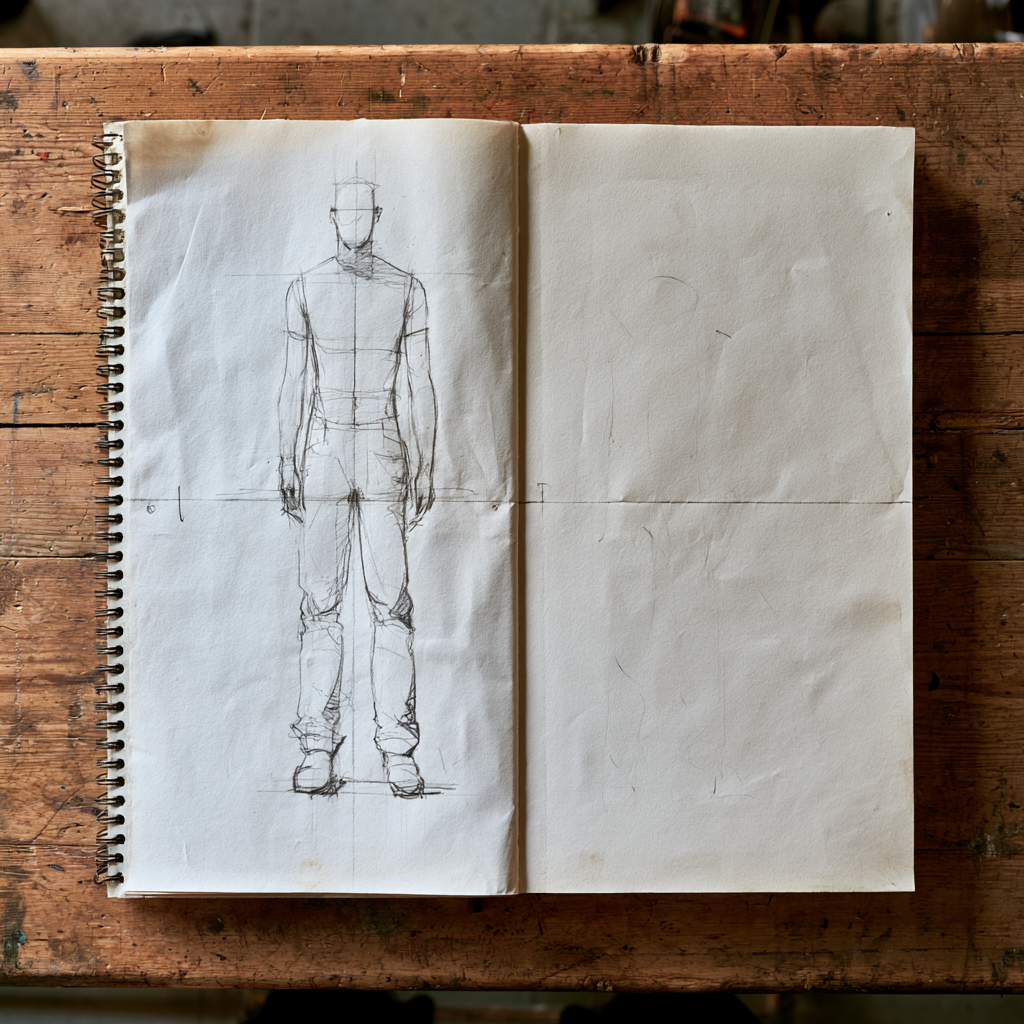
Studio exercise.
Now change the scale
KEEP THE PROPORTIONS THE SAME. CHANGE THE SIZE RELATIONSHIP.
WHAT TELLS YOU THE SCALE?
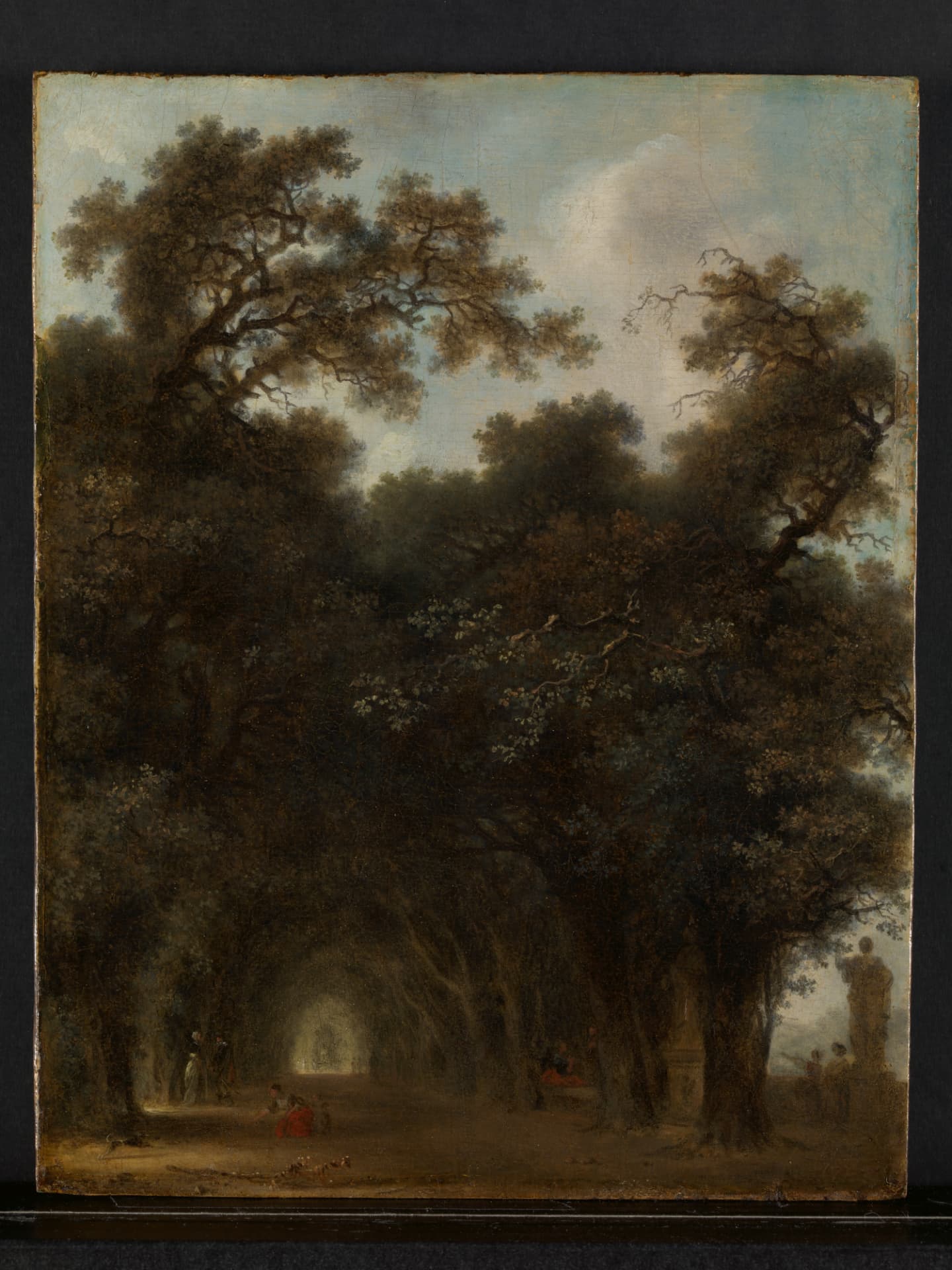
Look at the trees.
How large do they appear compared with the figures and the space around them?
What are you using to judge their size?
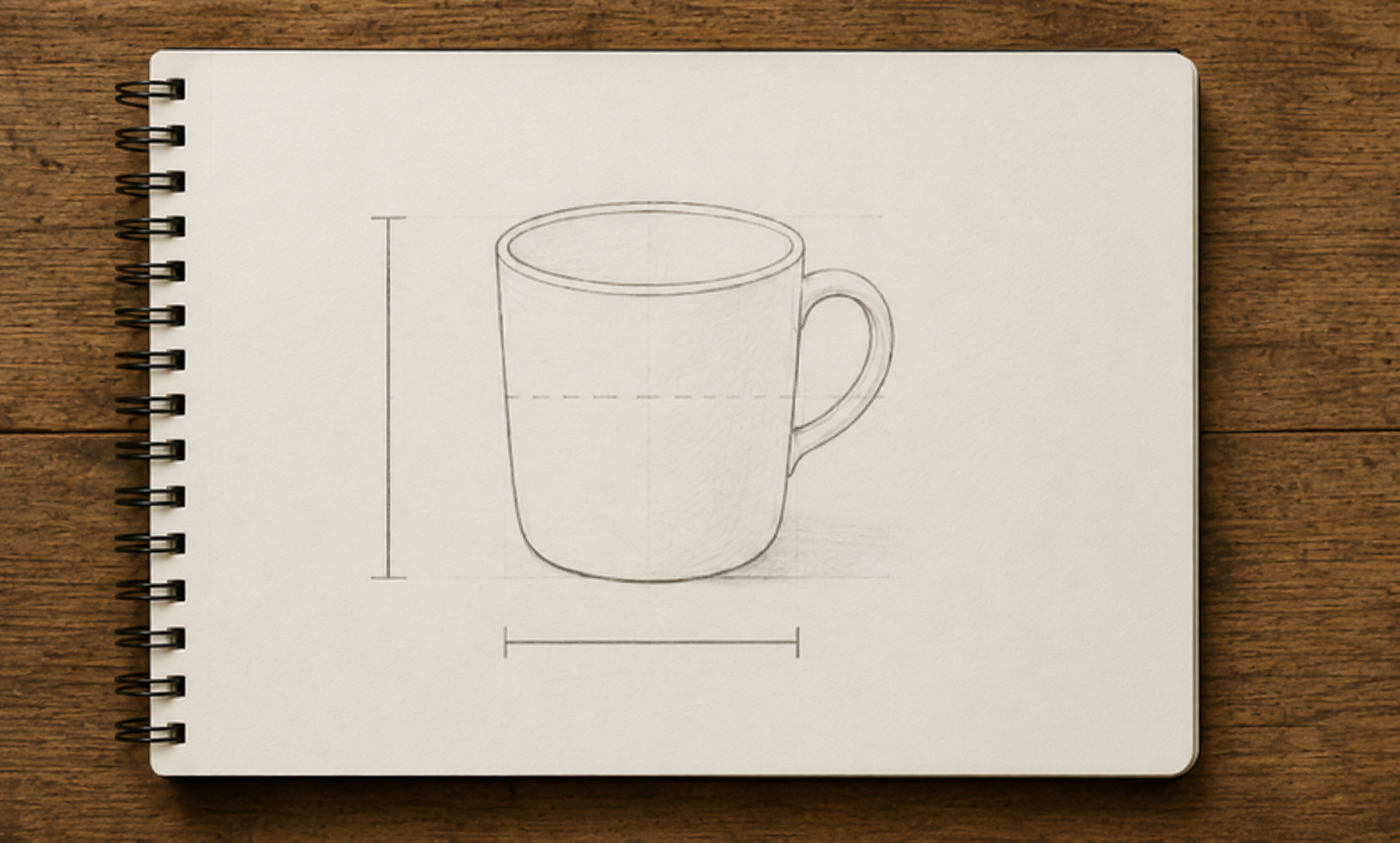
ONE CUP, THREE SCALES
01 / Small
The cup is very small in relation to a room.
02 / Expected
The cup appears an ordinary size on a table.
03 / Enormous
The cup is extremely large beside a person.
THE CUP KEEPS THE SAME PROPORTIONS. ITS SCALE CHANGES.
What changes when the cup becomes much smaller or larger than you expect?
CHANGE THE SCALE
Choose one ordinary object: a shoe, cup, key, pencil, chair, plant or spoon.
Draw it three times. Keep its proportions the same.
Change its size in relation to:
- the page
- another object
- a person or the space around it
01 SMALL → 02 EXPECTED → 03 ENORMOUS
Compare the three drawings.
What changes when the object becomes very small or very large?
Look again
COMPARE + CHANGE
Where did comparison help you correct a proportion?
What did measuring make you notice?
When you changed the scale, what changed about the way the object was experienced?
PROPORTION COMPARES PARTS.
SCALE COMPARES ONE THING WITH SOMETHING ELSE.
In practice
Artists can observe proportion closely or deliberately change scale. Changing scale can affect how a subject is experienced.
The size of an artwork and its relationship to the viewer or exhibition space can affect how the work is experienced.
Designers use proportion and scale when representing objects and considering how objects, environments and other designs relate to people and their surroundings.
Creative thinking
What size relationship did you notice only after measuring?
What changed when you changed the scale?
Keep one comparison that helped you adjust your work.
Tools to help you notice, describe, question, develop and document your work.
Curriculum + reading
Greenwood, D. (2023). Art creative practice: VCE units 1–4. Cambridge University Press & Assessment.
Guthrie, K. (2017). Nelson visual communication design: VCE units 1–4 (4th ed.). Cengage Learning Australia.
Victorian Curriculum and Assessment Authority. (2022). VCE Art Creative Practice study design 2023–2027. vcaa.vic.edu.au ↗
Victorian Curriculum and Assessment Authority. (2022). VCE Art Making and Exhibiting study design 2023–2027. vcaa.vic.edu.au ↗
Victorian Curriculum and Assessment Authority. (2023). VCE Visual Communication Design study design 2024–2028. vcaa.vic.edu.au ↗
Artists + artworks
Fragonard, J. H. (ca. 1775). A shaded avenue [Oil on wood]. The Metropolitan Museum of Art, The Jules Bache Collection, New York, NY, United States. Public domain. metmuseum.org ↗
Studio material
MUG + BOWL.
Measure by Comparison.
COMPARING PARTS.
Using a Unit.
HEIGHT + WIDTH.
Observational Proportion.
One Cup, Three Scales.
Visual material: Studio work, 2026.